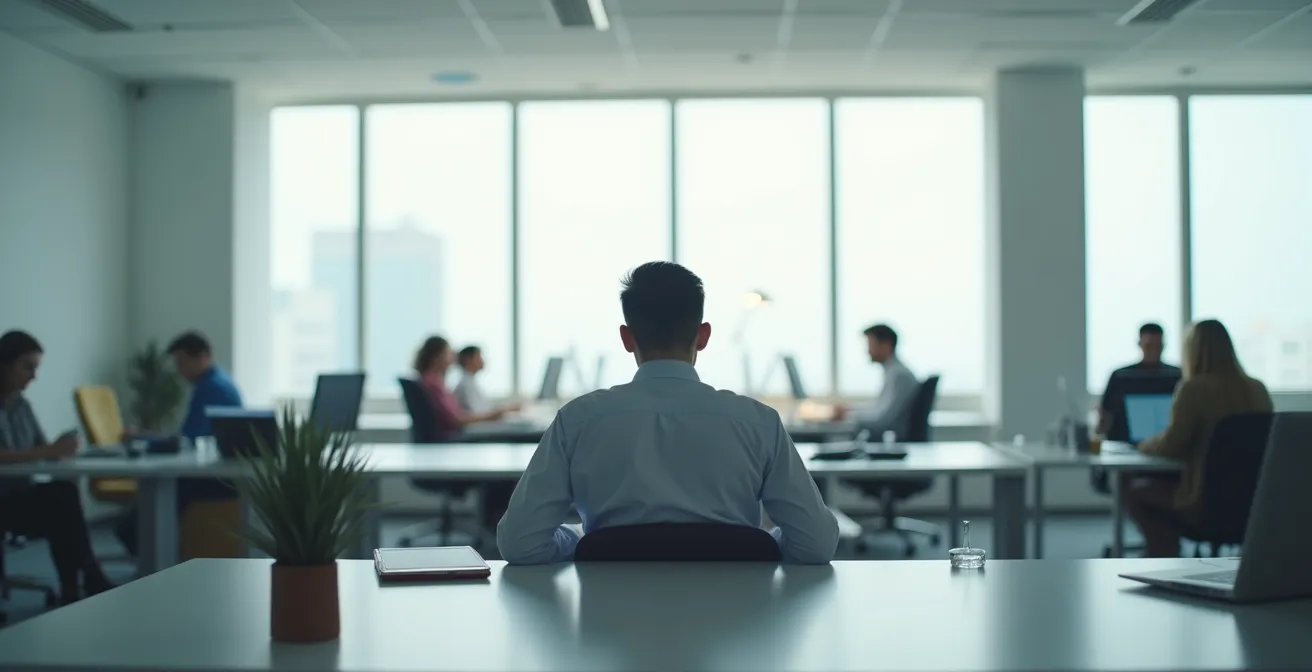
Tackling open office distractions with noise-cancelling headphones is a losing battle; true productivity comes from redesigning the system, not just patching its flaws.
- Shift from synchronous, high-cost meetings to asynchronous updates to reclaim valuable focus hours.
- Measure productivity by the value of output and problems solved, not by hours worked or tasks completed.
Recommendation: Treat your team’s focus as a quantifiable business asset and build a formal Communication Charter to protect it.
As an operations manager or team lead, you witness it daily: the constant hum of the open office, the endless pings from chat apps, the shoulder taps that shatter concentration. You’ve equipped your team with the best noise-cancelling headphones and encouraged them to block “focus time” on their calendars, yet true productivity remains elusive. The root of the problem isn’t a lack of individual discipline; it’s a flawed system that mistakes busyness for effectiveness and defaults to interruption as the primary mode of communication.
The conventional wisdom tells us to fight distractions on a personal level. We’re told to find a quiet corner, put up a “do not disturb” sign, and willpower our way through the noise. But these are temporary fixes, not strategic solutions. They place the burden of focus entirely on the employee, forcing them to swim against a powerful current of corporate culture that values immediate availability over deep, concentrated effort. This constant battle leads to shallow work, fragmented attention, and ultimately, burnout.
But what if the key wasn’t to build better individual shields, but to change the weather system itself? The true path to implementing deep work in a distracted environment is a strategic, operational shift. It requires treating your team’s collective focus not as a personal responsibility, but as a critical business asset that must be managed and protected. It involves a conscious redesign of communication protocols and a fundamental redefinition of what productivity truly means.
This article will guide you through this systemic change. We will dismantle the costly habits of synchronous work, provide a framework for measuring what truly matters—output, not hours—and equip you with the tools to build a culture where deep work isn’t just a hopeful calendar entry, but the default state for high-value tasks.
For those who prefer a condensed, visual format, the following video offers a powerful system for integrating deep work into your professional life, complementing the strategies we will explore.
To navigate this operational transformation, we will explore the essential pillars for building a culture of focus. This guide breaks down the financial and human cost of the always-on culture and provides a clear roadmap for creating a more productive and sustainable work environment.
Summary: A Manager’s Guide to Reclaiming Focus and Output
- Why Your 1-Hour Weekly Status Meeting Costs the Company $50,000/Year?
- How to Move Updates to Asynchronous Channels to Save 10 Hours a Week?
- Results vs Hours: Why Tracking Time Is the Wrong Way to Measure Productivity?
- The Hustle Trap: When High Productivity Masks Pending Burnout
- How to Structure Onboarding to Get New Hires Fully Productive in 30 Days?
- Why “Waiting Time” Is the Most Expensive Waste in Your Workflow?
- Why a Physical Kanban Board Beats Digital Tools for Office Engagement?
- How to Build a Learning Culture That Retains Ambitious Employees?
Why Your 1-Hour Weekly Status Meeting Costs the Company $50,000/Year?
The weekly status meeting feels like an institution, a non-negotiable part of the corporate rhythm. Yet, it’s often the single most expensive, low-impact activity on your team’s schedule. To understand its true cost, you must look beyond the hour spent in the room. Consider a team of ten mid-level employees. A simple calculation based on average salaries reveals a direct cost of thousands of dollars for that single meeting. Extrapolated over a year, this one recurring meeting can easily exceed $50,000 in salary cost alone. This doesn’t even account for the hidden costs.
The most significant damage is the “context switching” penalty. Each employee needs time before the meeting to disengage from their deep work, prepare updates, and mentally shift gears. After the meeting, they require even more time to re-immerse themselves in complex tasks. This preparation and recovery time effectively doubles or triples the meeting’s true duration. As a manager, your role is to treat focus as a tangible asset. Quantifying the cost of meetings is the first step in demonstrating that the default to synchronous communication is a massive financial drain.
This isn’t just a theoretical exercise. In a famous analysis, it was found that a single weekly meeting of midlevel managers at one large corporation was costing the organization $15 million annually when all direct and indirect costs were factored in. These gatherings, intended to create alignment, often become forums for “FYI” updates that could have been an email or a shared document. By failing to protect your team’s most productive hours, you are inadvertently sanctioning a massive waste of resources that could be invested in innovation and problem-solving.
The goal is not to eliminate all meetings, but to make them intentional and reserved for high-stakes collaboration and problem-solving, not routine status checks.
How to Move Updates to Asynchronous Channels to Save 10 Hours a Week?
The solution to the costly meeting problem lies in a deliberate shift to asynchronous communication. This doesn’t mean working in silos; it means replacing low-value, real-time “FYI” conversations with structured, written updates. The goal is to create a “communication charter” for your team, a formal agreement on which channels to use for different types of information. This charter distinguishes between urgent blockers that require a synchronous call and status updates that can be shared in a project management tool, a dedicated chat channel, or a weekly email digest.
By moving status reports, announcements, and non-urgent questions to asynchronous channels, you empower your team to engage with information on their own terms. Instead of being forced to break their flow for a scheduled meeting, they can review updates during natural breaks in their day. This simple change can reclaim a significant amount of productive time. For many knowledge workers, the constant barrage of meetings and notifications fragments their day into tiny, unproductive slivers of time, making deep work impossible. A well-designed asynchronous system can help recover up to 10 hours of focused work per week for each team member.
The key is to differentiate the purpose of communication and choose the right tool for the job. This structured approach respects everyone’s time and protects the most valuable resource you have: your team’s uninterrupted concentration.
| Communication Type | Response Time | Best Use Case | Deep Work Impact |
|---|---|---|---|
| FYI Updates (Async) | No response needed | Status reports, announcements | Zero interruption |
| Questions (Async) | Within 24 hours | Non-urgent clarifications | Minimal disruption |
| Blockers (Sync) | Immediate | Critical issues only | Justified interruption |
This framework is not about avoiding communication but about making it more effective. It transforms the default from “let’s jump on a call” to “let’s document this clearly,” freeing up cognitive bandwidth for the work that truly matters.
Implementing this shift requires clear guidelines and consistent reinforcement from leadership, turning it from a nice idea into a core operational habit.
Results vs Hours: Why Tracking Time Is the Wrong Way to Measure Productivity?
In knowledge work, the industrial-era mindset of “hours worked equals output” is not just outdated; it’s actively harmful. An open office culture that values “butts in seats” and immediate responsiveness encourages shallow, visible work over deep, impactful progress. As a manager, your most crucial paradigm shift is to move from measuring inputs (time) to measuring outputs (results). True productivity isn’t about being busy for eight hours; it’s about solving a complex problem, shipping an innovative feature, or creating a valuable asset.
Deep work is mentally taxing. As productivity expert Cal Newport notes, “Deep work is exhausting because it pushes you toward the limit of your abilities.” Tracking hours incentivizes presence, not performance. It can lead employees to fill their days with performative busyness—answering emails instantly, attending every meeting—to signal their commitment, while the truly difficult, high-value work gets pushed aside. This creates a culture where the appearance of productivity is more important than actual progress.

Instead of time sheets, focus on output-based metrics. These can include: the rate of feature innovation, the time it takes to resolve complex customer issues, or the reduction in system errors. These metrics align the team’s efforts with business goals. They also give employees the autonomy to manage their own time, empowering them to block out several hours for deep work without feeling guilty for being unresponsive on chat. This shift requires trust, but it’s the only way to unlock the true potential of your team.
When you start measuring what matters, your team will start focusing on what matters, and the distractions of the open office will begin to lose their power.
The Hustle Trap: When High Productivity Masks Pending Burnout
As you shift towards measuring results, a new danger emerges: the hustle trap. In a culture that celebrates high output, it’s easy for ambitious employees to equate productivity with working relentlessly. They may embrace deep work blocks, but they do so by extending their workdays, sacrificing breaks, and blurring the lines between work and life. This approach can yield impressive short-term results, but it’s a direct path to burnout. The goal of implementing deep work is not to extract more hours from your team, but to increase the value generated within a sustainable workday.
Managers are particularly vulnerable to this trap, both for themselves and their teams. With recent workplace statistics revealing that middle management spends 35% of their time in meetings and senior management up to 50%, the pressure to “catch up” on real work after hours is immense. This behavior sets a powerful and dangerous precedent for the entire team. It signals that long hours are the only way to succeed, undermining any efforts to create a culture of focused, sustainable work.
To avoid this, you must actively champion rest and disconnection. True productivity is a cycle of intense focus followed by genuine downtime. Encourage your team to take their breaks, to fully disconnect after work, and to use their vacation time. Make it clear that sustainable performance is the goal, not heroic sprints that lead to exhaustion. Celebrate the team member who solves a difficult problem in a four-hour deep work session and then logs off on time, not the one who stays until midnight answering emails. As a leader, your own work habits are the most powerful message you can send.
By decoupling productivity from sheer effort, you build a resilient team that can perform at a high level for the long haul, rather than burning out in a blaze of short-term glory.
How to Structure Onboarding to Get New Hires Fully Productive in 30 Days?
The first 30 days of a new hire’s experience are formative. This is your single best opportunity to instill the principles of deep work and asynchronous communication before the habits of a distraction-heavy culture take root. A structured onboarding process focused on work habits, not just technical skills, is essential. Instead of throwing a new employee into a sea of meetings and chat notifications, you must intentionally guide them toward a culture of focus.
The first week should be dedicated to introducing the “why” behind your work philosophy. This includes a thorough walkthrough of your team’s communication charter, explaining when to use synchronous versus asynchronous tools. Schedule their first deep work blocks in their calendar from day one, even for simple, introductory tasks. This immediately establishes that uninterrupted focus time is a core part of their job, not a luxury. Pairing them with a “Deep Work Buddy”—a seasoned team member who models good focus habits—can be incredibly effective.
Over the next few weeks, gradually increase the duration and complexity of their deep work sessions. The goal is a ramp-up plan that builds their “focus muscle” progressively. For example, using a framework like the 4 Disciplines of Execution (4DX) can help new hires immediately focus on “wildly important goals.” This involves tracking lead measures (like time spent in deep work) rather than lag measures (like project completion), maintaining a compelling scoreboard of progress, and establishing a cadence of accountability. This structured approach helps them build confidence and deliver meaningful results quickly, reinforcing the value of the deep work culture you are building.
By embedding these principles from the very beginning, you create champions of your culture who will help protect and promote it as your team grows.
Why “Waiting Time” Is the Most Expensive Waste in Your Workflow?
In manufacturing, “waiting time” is one of the seven deadly wastes (muda) that destroy efficiency. In knowledge work, this waste is even more insidious because it’s largely invisible. It’s not just the time spent waiting for a meeting to start; it’s the countless minutes and hours lost to mental recalibration after an interruption, waiting for a decision from a colleague, or being blocked on a task due to a dependency. This cumulative “waiting time” is a massive drain on productivity, and Bloomberg research indicates that unnecessary meetings waste $25,000 annually per employee, much of which is rooted in this hidden cost.
The most damaging form of waiting time is the mental recalibration cost. Research shows it can take over 23 minutes to regain a deep state of focus after a single interruption. An open office with a culture of constant shoulder taps and “quick questions” is effectively imposing this 23-minute tax multiple times a day on every employee. The second form is dependency waiting, where progress halts until someone else provides information or approval. This is often a direct result of poor asynchronous documentation.

As a manager, your job is to hunt down and eliminate these sources of waste. This is where protected deep work blocks and a strong asynchronous culture pay dividends. They drastically reduce interruptions, minimizing mental recalibration time. A commitment to thorough documentation empowers team members to find answers themselves, reducing dependency waiting.
The following table breaks down the primary types of waiting time in a typical office environment and outlines the systemic solutions to combat them.
| Waiting Type | Average Duration | Productivity Impact | Solution |
|---|---|---|---|
| Mental Recalibration | 23 minutes per interruption | High – destroys flow state | Protected deep work blocks |
| Dependency Waiting | 2-4 hours per week | Medium – delays progress | Async documentation |
| Meeting Transitions | 15 minutes per meeting | Low-Medium – fragments day | Batch meetings |
By making this invisible waste visible and systematically addressing its root causes, you can unlock a significant amount of productive capacity without asking your team to work harder or longer.
It transforms the manager’s role from a simple overseer of tasks to a true architect of an efficient and focused work system.
Why a Physical Kanban Board Beats Digital Tools for Office Engagement?
In a world of sophisticated digital project management tools, advocating for a physical whiteboard and sticky notes can seem counterintuitive. However, for a team working in a shared physical space, a physical Kanban board offers unique advantages for fostering a culture of deep work. Its primary benefit is its high-visibility, low-distraction nature. Unlike a digital tool that requires opening an app and risks pulling a user into a vortex of notifications, the physical board is a calm, ambient source of information for everyone in the room.
A well-designed physical board can become the central nervous system of your team’s workflow and a powerful, non-verbal communication tool. By creating a dedicated “Deep Work in Progress” column, you create a clear, visual “do not disturb” signal. When a team member’s card is in that column, everyone understands they are in a state of flow and should not be interrupted for non-critical issues. This is far more effective than a Slack status that is easily overlooked. The physical act of moving a card from “To Do” to “In Progress” to “Done” also creates a tactile sense of accomplishment and momentum that digital tools often fail to replicate.
Implementing a physical board can be simple but powerful. A daily 10-minute stand-up meeting around the board—a “Focus Huddle”—can replace hours of status meetings. It keeps everyone aligned on priorities and surfaces blockers quickly. This tangible interaction with the workflow builds a shared sense of ownership and makes progress visible to the entire team, reinforcing the value of focused effort.
Your Action Plan: Implementing a Physical Kanban Board for Focus
- Create Clear Columns: Start with simple columns like ‘Backlog’, ‘To Do’, ‘Deep Work in Progress’, and ‘Done’. The ‘Deep Work’ column is your critical signal.
- Use Color-Coded Cards: Assign different colors to tasks based on the level of focus required (e.g., red for high-focus deep work, yellow for collaborative tasks).
- Establish Central Placement: Position the board in a high-traffic area where it is easily visible to the entire team without being a direct interruption.
- Implement a Daily Focus Huddle: Schedule a brief, 10-minute stand-up meeting around the board each morning to align on priorities and identify blockers.
- Encourage Tactile Engagement: Foster the habit of physically moving cards across the board to create a tangible connection to work progress and build momentum.
It’s a simple, low-tech solution that can have a profound impact on the complex dynamics of an open office environment.
Key Takeaways
- The financial and productivity cost of interruptions and low-value meetings is a massive, often invisible, drain on company resources.
- Shifting to an “asynchronous-first” communication model and measuring output instead of hours are fundamental paradigm shifts for modern productivity.
- Building a culture of deep work is a systemic, top-down process that must be embedded in onboarding, daily rituals, and management philosophy.
How to Build a Learning Culture That Retains Ambitious Employees?
The ultimate benefit of cultivating a deep work culture extends beyond immediate productivity gains. It becomes a powerful engine for employee retention, especially for your most ambitious team members. Talented individuals crave mastery. They want to develop their skills, tackle challenging problems, and feel a sense of professional growth. A work environment characterized by constant distraction and shallow work is toxic to this ambition. It denies them the very thing they need to thrive: the space to think, learn, and create.
By protecting your team’s focus, you are not just enabling them to complete their current tasks more efficiently; you are giving them the time and mental space to learn and innovate. This is where you can formally implement “Protected Learning Blocks.” These are scheduled, sacrosanct periods of deep work dedicated entirely to skill development, research, or exploring new ideas. When learning is treated as a core job responsibility rather than an afterthought, you send a clear message that you are invested in your team’s long-term growth.
Companies that successfully implement this find they don’t just get better work; they keep better people. The ability to offer a focused, low-distraction environment becomes a significant competitive advantage in the war for talent. When ambitious employees see a clear link between protected deep work time, skill development, and career progression, their engagement and loyalty skyrocket. They see their job not just as a series of tasks, but as a platform for achieving mastery. This transformation from a task-based culture to a learning culture is the highest expression of a successful deep work implementation.
To truly embed this culture, your next step is to audit your team’s current communication habits and draft your first Communication Charter, making focus a non-negotiable part of your operational DNA.
Frequently Asked Questions about Deep Work in the Office
How much time should be allocated to learning blocks?
Start with 2-4 hours per week of protected deep work time specifically for learning, gradually increasing based on role requirements. The key is consistency and ensuring this time is treated as an unmovable commitment.
How do you protect learning time from meeting creep?
Treat learning blocks as unmovable calendar events with the same importance as a client meeting. Leadership must communicate their strategic value to the whole team and measure their impact on skill development to justify their protection.
What’s the ROI of protected learning time?
The return on investment is multifaceted. Companies report improved retention of ambitious employees, faster development of critical skills, and increased innovation as team members have the space to connect ideas and solve deeper problems.