
The promise of Agile often clashes with the reality of creative work, leading to frustration and “fake agile” that stifles innovation.
- True agility in marketing isn’t about rigid ceremonies, but about creating psychological safety and a relentless focus on value.
- Human-centric rituals and physical tools can unlock far more engagement and creativity than any complex software.
Recommendation: Start by reframing Scrum as a system to protect your team’s creative focus, not just another process to be followed.
Marketing leaders are under constant pressure to be both brilliantly creative and rigorously data-driven. The promise of “Agile” and “Scrum” often seems like the perfect solution: a way to deliver faster, pivot on a dime, and prove value. Yet, many teams who attempt this transition find themselves in a worse position. They meticulously copy the rituals of software development—daily stand-ups, sprint planning, retrospectives—only to discover they’ve created more meetings, more process, and a system that feels like it’s actively fighting the free-flowing nature of creative work.
This is the “fake agile” trap, a cargo cult where teams perform the ceremonies without embracing the underlying mindset. The result is a process that stifles the very spark it was meant to organize. But what if the goal was never to adopt a rigid process in the first place? What if the true path to agility for creative teams lies in building a system that channels creative chaos into focused, high-impact outcomes? The key isn’t in the ceremonies themselves, but in using them to build a foundation of focus, experimentation, and psychological safety.
This guide will deconstruct the common pitfalls of implementing Scrum in a marketing context. We will move beyond the textbook definitions to explore tangible practices that fuel, rather than fight, creativity. From rethinking the purpose of a stand-up to learning how to celebrate intelligent failure, you’ll discover how to adapt the principles of Scrum to build a truly agile creative engine.
The following sections break down the core components for successfully adapting Scrum to your creative environment. Discover practical strategies to transform your team’s workflow and mindset, moving from rigid process to genuine agility.
Summary: Implementing Scrum for Creative and Marketing Teams
- Why a Physical Kanban Board Beats Digital Tools for Office Engagement?
- How to Run a 15-Minute Stand-Up That Doesn’t Feel Like a Status Update?
- Waterfall vs Agile: Why Traditional Planning Fails for Modern Campaigns?
- The “Fake Agile” Trap: Doing the Ceremonies Without Changing the Mindset
- How to Facilitate a Retrospective That Actually Solves Recurring Problems?
- How to Celebrate Failure Without Encouraging Incompetence?
- How to Sequence Your Launch: Product, Legal, or Marketing First?
- How to Apply Lean Principles to Service Businesses Without Killing Creativity?
Why a Physical Kanban Board Beats Digital Tools for Office Engagement?
In an age dominated by sophisticated digital project management tools, the idea of using a physical wall with sticky notes can seem archaic. However, for creative teams, a physical Kanban board is often a superior tool for fostering engagement and shared understanding. Unlike a digital tool, which is a private experience on an individual’s screen, a physical board becomes a public and tangible information radiator. It creates a natural gathering point, turning the act of “walking the board” into a powerful team ritual. This shared physical space makes progress, blockers, and priorities impossible to ignore, fostering a level of collective ownership that digital tools struggle to replicate.
The true power of this approach is in managing creative energy by making constraints visible. By setting explicit Work in Progress (WIP) limits—for example, “no more than three active tasks per person”—the board forces the team to focus on finishing work rather than starting new things. This simple rule is a powerful antidote to the context-switching that drains creative capacity. In fact, research from CA Technologies reveals that teams aggressively controlling WIP can cut their process time in half and see 25% fewer defects.
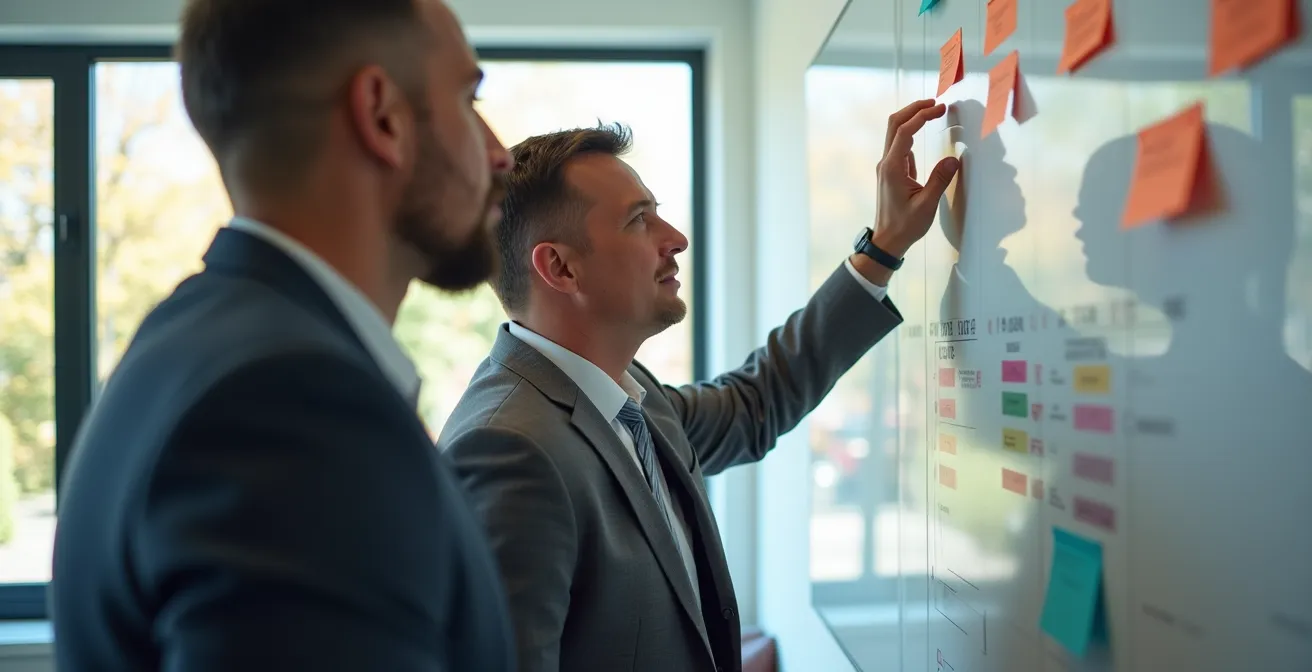
As the image suggests, the physical board is a locus for human interaction and strategic alignment. It’s not just about tasks; it’s about conversations. A well-managed board becomes a living document of the team’s journey, displaying not just to-do lists but also key metrics, customer feedback, and campaign visuals. This transforms a simple process tool into a rich storytelling device that connects the team’s daily efforts to the larger strategic goals.
Case Study: IBM’s Physical Agile Hubs Transformation
In 2016, IBM’s CMO initiated a massive transformation by bringing 2,600 marketers back into physical offices to implement Agile. The core of this change revolved around in-person hubs centered on physical Kanban boards and face-to-face collaboration. The results were staggering: turnaround times for marketing tasks plummeted from two months to as little as two hours. This shift not only saved millions by creating an efficient in-house agency model but also proved that for creative collaboration, tangible, high-visibility tools can dramatically outperform their digital counterparts.
Ultimately, a physical board’s greatest strength is its humanity. It encourages conversation over clicks, visibility over hidden menus, and a shared reality over siloed digital dashboards. For a creative team, where collaboration and energy are paramount, this low-tech solution often yields the highest returns on engagement.
How to Run a 15-Minute Stand-Up That Doesn’t Feel Like a Status Update?
The daily stand-up is often the first Scrum ritual to become a source of dread for creative teams. It quickly devolves into a monotonous round-robin of status reports where each person recites their to-do list for the manager. This format is not only boring but fundamentally misses the point. The purpose of a stand-up is not to report on the past; it’s to align on the present and accelerate the future. It should be a 15-minute tactical huddle focused on collaboration and removing impediments, not a “prove you’re working” session.
To break this cycle, shift the focus from individual activity to the team’s collective goal. Instead of asking, “What did you do yesterday, and what will you do today?” frame the meeting around a single, powerful question: “What is the most important thing our team can achieve today to advance our sprint goal?” This transforms the conversation from a series of monologues into a strategic dialogue. It encourages team members to think about dependencies and offer help proactively, fostering a sense of shared responsibility for the outcome.
Implementing a structured yet flexible format can keep the energy high and the meeting on track. Dedicate a specific portion of the meeting, perhaps a 60-second “Help Offered” round, where team members can explicitly offer their skills to unblock others. Another technique is to rotate a “daily lens,” where for one minute, the team looks at a specific factor like recent competitor activity or new customer feedback. This keeps the ritual fresh and connects daily work to the outside world, ensuring the team doesn’t become too inwardly focused.
By reframing the stand-up as a daily alignment and problem-solving session, it becomes one of the most valuable rituals in a creative team’s toolkit. It ceases to be a chore and transforms into a vital daily injection of focus, collaboration, and collective momentum, all accomplished in less time than it takes to brew a pot of coffee.
Waterfall vs Agile: Why Traditional Planning Fails for Modern Campaigns?
Traditional marketing often operates on a “Waterfall” model: a long, sequential process of planning, creating, and launching a large campaign over many months. This approach treats marketing like constructing a building—every detail is blueprinted in advance, and changes are costly and discouraged. While this provides a sense of predictability, it’s a fragile system in today’s fast-moving digital landscape. A six-month campaign plan is a massive bet that the market, competitors, and customer preferences won’t change in that time—a bet that is almost guaranteed to lose.

The Agile approach, in contrast, treats marketing more like navigating a ship than building a skyscraper. The destination (the strategic goal) is clear, but the exact route is adjusted based on real-time feedback—the winds and currents of market data. Instead of one massive launch, Agile marketing focuses on delivering value in small, iterative cycles called sprints. This allows the team to test ideas, measure results, and pivot quickly. It transforms a single, high-risk bet into a series of smaller, intelligent experiments, drastically reducing the cost of failure and maximizing the potential for success.
This difference is starkly visible in budget allocation and ROI. The Waterfall method often locks in huge budgets for unproven concepts, while Agile allows for small, incremental investments that are scaled up only after they’ve demonstrated results. This shift is not just a process change; it’s a fundamental business advantage. In fact, MIT research demonstrates that Agile firms grow revenue 37% faster and generate 30% higher profits than their non-Agile counterparts, proving the immense financial impact of this adaptive approach.
The following table illustrates the practical differences in how these two methodologies handle key aspects of a marketing campaign, highlighting the superior risk management and optimization potential of the Agile model.
| Aspect | Waterfall Approach | Agile Approach | Business Impact |
|---|---|---|---|
| Budget Allocation | $50k for a single video shoot | $5k per sprint to test and iterate on video concepts | Risk reduced by 90% |
| Time to Market | 6-month campaign development | 2-week sprint deliverables | 35% faster delivery |
| ROI Optimization | Annual review and adjustment | Bi-weekly optimization cycles | 150-300% ROI within first year |
| Failure Cost | Full budget at risk | Only sprint budget at risk | 22% reduction in rework |
Ultimately, the Waterfall model is built for a stable world that no longer exists. For modern marketing, where the only constant is change, clinging to rigid, long-term plans is not a strategy for success—it’s a recipe for creating expensive, out-of-touch “zombie campaigns” that fail to connect with their audience.
The “Fake Agile” Trap: Doing the Ceremonies Without Changing the Mindset
One of the biggest hurdles in adopting Scrum for marketing is the “Fake Agile” trap. This happens when a team meticulously adopts the ceremonies—stand-ups, sprints, retrospectives—but misses the fundamental mindset shift required for them to work. The meetings happen, the board is updated, but the underlying culture remains one of command-and-control. Management still dictates tasks, failure is still punished, and the team lacks the autonomy to make real decisions. This is merely a new, more frustrating layer of bureaucracy painted with an “Agile” brush.
True agility is not about process; it’s about empowerment and a focus on value. As Scrum co-creator Jeff Sutherland stated, the core idea is simple: regularly check if you’re heading in the right direction and building what people actually want. This requires a culture of trust and psychological safety, where the team is empowered to experiment, to say “no” to new requests mid-sprint to protect their focus, and to own their commitments.
Scrum is based on a simple idea: whenever you start a project, why not regularly check in, see if what you’re doing is heading in the right direction, and if it’s actually what people want?
– Jeff Sutherland, Scrum Co-Creator
The difference between real and fake Agile lies in who holds the power. In a truly Agile environment, the team pulls work from the backlog, deciding how much they can realistically commit to in a sprint. In a “Fake Agile” setup, work is pushed onto them by management. Velocity metrics are used by the team for forecasting and improvement, not by managers for performance reviews. This shift from commanding output to providing context and trusting the team is the single most important factor for success.
Your Action Plan: Litmus Test for True Agile Empowerment
- Decision-Making Authority: Can the team say NO to a senior stakeholder’s request mid-sprint to protect the sprint goal? Assess all points where creative or strategic decisions are made.
- Process Ownership: Inventory who truly owns the backlog and sprint commitments. Does the team pull work based on their capacity, or is work pushed onto them?
- Psychological Safety: Confront the team’s reality with Agile values. Is there a genuine safety to experiment and fail, or is failure implicitly punished?
- Metric Usage: Review how data is used. Are velocity and other metrics used by the team for improvement (learning) or by management for judgment (punishment)?
- Leadership’s Role: Create a clear plan for leadership to transition from giving commands to providing strategic context and trusting the team to find the solution.
Escaping this trap requires courage from leadership to cede control and trust their team. It means shifting the measure of success from “did you complete the tasks I gave you?” to “did you deliver the value we agreed upon?” Without this foundational mindset shift, Scrum is just a new set of rules in the same old game.
How to Facilitate a Retrospective That Actually Solves Recurring Problems?
The sprint retrospective is arguably the most critical ritual in Scrum, yet it’s often the most poorly executed. For many teams, it becomes a “complaint session” where the same issues are raised sprint after sprint with no resolution, or an awkward meeting where no one wants to speak up. A great retrospective is not about venting; it’s a structured, safe, and action-oriented session designed to make the team’s process incrementally better. Its purpose is to move from identifying symptoms to diagnosing and treating the root cause of a recurring problem.
One of the most effective techniques to achieve this is the “5 Whys.” This simple but powerful method forces the team to look beyond the surface-level problem. Instead of stopping at “the campaign failed,” a facilitator guides the team to ask “Why?” repeatedly until they uncover the systemic issue. This structured inquiry prevents the team from settling on easy, superficial answers and drives them toward a root cause they can actually address. This process turns a session of blame or frustration into a collaborative investigation.
The “5 Whys” Technique Applied to a Failed Marketing Campaign
A marketing team’s retrospective started with the problem: “The campaign failed.” By applying the “5 Whys,” they dug deeper. 1. Why? “The message didn’t resonate.” 2. Why? “We used the wrong tone.” 3. Why? “We didn’t have a clear persona.” 4. Why? “We skipped user research due to time constraints.” 5. Why? “We didn’t allocate sprint capacity for research.” This root cause analysis led to an actionable solution: dedicating 20% of each future sprint to user research. This small process change resulted in a 40% improvement in subsequent campaign performance.
The success of a retrospective hinges on psychological safety. Team members must feel safe enough to be vulnerable, admit mistakes, and challenge the status quo without fear of blame. A facilitator’s primary job is to create this container of trust. This can be done by setting clear ground rules (e.g., “we seek to understand, not to blame”) and using anonymous data-gathering techniques (like writing issues on sticky notes before discussing them). The goal is to generate a small number of concrete, actionable improvement items that can be implemented in the next sprint. The impact is significant; according to CA Technologies research, teams with regular sprint retrospectives have 24% more responsiveness and 42% higher quality.
Ultimately, a retrospective that doesn’t produce at least one concrete experiment to try in the next sprint is a failed meeting. By focusing on root causes and actionable outcomes within a safe environment, the retrospective transforms from a dreaded chore into the team’s most powerful tool for growth and mastery.
How to Celebrate Failure Without Encouraging Incompetence?
The Agile mantra to “fail fast” and “celebrate failure” can be deeply unsettling for leaders and high-performers. It sounds like an invitation for lower standards and a lack of accountability. However, the key to unlocking innovation is not to celebrate all failure, but to differentiate between sloppy mistakes and intelligent failures. A sloppy mistake is a failure in an area of known process or established best practice—these should be corrected and learned from, but not celebrated. An intelligent failure, on the other hand, is the undesirable outcome of a well-designed experiment conducted in an area of high uncertainty. These are the “failures” that provide valuable learning and must be celebrated.
To create this culture, leaders must provide a clear framework. This starts by defining the criteria for an “intelligent failure”: was there a clear hypothesis? Was the experiment well-designed to test it? Was it conducted in a new or uncertain territory? When a failure meets these criteria, it should be treated as a successful learning outcome. This creates the psychological safety needed for teams to take smart risks. Agile marketing teams naturally lean into this, as they are more data-driven; in fact, Gartner research shows that Agile marketing teams use an average of 7.5 metrics compared to 5.9 for non-agile teams, enabling them to better quantify the results of their experiments.
Instituting formal rituals can help embed this practice into the team’s culture. For example, creating a “Noble Failure Award” each quarter for the experiment that didn’t meet its goal but produced the most valuable learning. Another powerful practice is the “Failure Résumé,” where team members document their failed experiments and the lessons gleaned. To make this real, leadership must put their money where their mouth is. This means establishing a dedicated “Experimentation Budget”—perhaps 10% of the total marketing budget—explicitly allocated to high-risk, high-learning initiatives where a traditional ROI is not the primary measure of success.
By clearly distinguishing between preventable errors and valuable experiments, leaders can build a culture that is both highly accountable and fiercely innovative. Celebrating intelligent failure isn’t about encouraging incompetence; it’s about rewarding the courage to explore the unknown, which is the very source of breakthrough creative work.
Key Takeaways
- Focus on the Agile mindset over mechanics; true agility comes from empowerment and trust, not just ceremonies.
- Human-centric rituals and tangible tools like physical Kanban boards often drive more engagement and clarity for creative teams than complex software.
- Create psychological safety by celebrating “intelligent failures”—well-designed experiments that yield learning—to foster the courage required for innovation.
How to Sequence Your Launch: Product, Legal, or Marketing First?
The traditional product launch sequence is a relay race fraught with bottlenecks. Product builds something, throws it over the wall to Marketing to create a story for it, and then at the last minute, it goes to Legal for a review that can derail the entire launch. This sequential approach is inefficient and inherently risky, as critical issues are often discovered too late. The Agile answer to the question, “Who goes first?” is a radical one: no one goes first because everyone starts together. It’s not a relay race; it’s a rugby match where the whole team moves down the field together.
This is achieved by forming cross-functional “Squads” or teams that include members from product, marketing, legal, and any other critical function from day one. Instead of operating in silos, these departments become embedded partners in the creation process. Legal provides guidance throughout each sprint, preventing last-minute roadblocks. Marketing co-creates the product narrative alongside its development, ensuring the final product and its story are perfectly aligned. This “parallel processing” model breaks down dependencies and creates a shared understanding and commitment to the outcome.
A “Sprint Zero” is often used to kickstart this process, where the entire cross-functional team comes together to define the goals, risks, and, most importantly, a shared “Definition of Ready” (what’s needed to start work) and “Definition of Done” (what a completed piece of work looks like for everyone). This initial alignment prevents the misunderstandings and conflicting priorities that plague sequential launches.
Case Study: Spotify’s Cross-Functional Squad Model
Spotify revolutionized the industry by organizing around autonomous, cross-functional “Squads” that included product, legal, and marketing from inception. Their approach, which embeds all functions in every sprint, enabled them to scale from a small startup to a global leader while maintaining incredible speed and agility. This parallel processing model was a key factor in their ability to reduce time-to-market by an estimated 66% compared to traditional sequential models, effectively managing risk and dependencies on a daily basis.
By dissolving the walls between departments and working in parallel, teams don’t just move faster; they build better, more compliant, and more marketable products from the very beginning. The question is no longer about sequence but about synergy.
How to Apply Lean Principles to Service Businesses Without Killing Creativity?
The term “Lean,” born from manufacturing, can sound cold and antithetical to the creative process. It conjures images of stopwatches and ruthless efficiency, which seems to threaten the space needed for inspiration. However, the core principle of Lean is not about “doing more with less.” As a marketing expert on Lean Agile principles once said, it’s about creating more value with less waste. When applied correctly to marketing, Lean becomes a powerful tool for channeling creative energy toward what truly matters, rather than squandering it on unproductive activities.
To apply Lean, you must first learn to see the “Eight Wastes” in a marketing context. These are not about physical scrap but about wasted effort and time. They include things like:
- Over-production: Creating a dozen ad variations when only two will be used.
- Waiting: Time lost waiting for approvals, feedback, or assets from another team.
- Unused Talent: Having a brilliant copywriter spend their days just proofreading social media posts.
- Defects: Campaigns that require multiple rounds of costly revisions due to unclear briefs.
- Over-processing: Creating a 50-page report that no one reads.
By identifying these wastes, a creative team can begin to streamline its process without touching the creative act itself. It’s about removing the friction *around* the creative work. For example, creating a clear and collaborative briefing process eliminates the waste of “Defects.” Establishing clear service-level agreements (SLAs) for approvals reduces the waste of “Waiting.” This frees up more time and mental space for the team to focus on what they do best: being creative. The business impact is undeniable; data-driven research confirms that companies can achieve a 40% increase in marketing ROI by implementing such Agile and Lean practices.
Applying Lean to marketing is not about turning artists into robots. It’s about protecting their most valuable resource—their creative focus—by systematically eliminating the bureaucratic and operational drag that consumes their energy and adds no value to the customer. It’s a system designed to liberate creativity, not kill it.